
In today’s competitive digital landscape, businesses need marketing strategies that generate measurable results—not just impressions or awareness. This is where performance marketing has become one of the most effective digital marketing approaches for modern businesses.
Unlike traditional marketing, where businesses pay upfront regardless of outcomes, performance marketing focuses on results. You invest in campaigns designed to generate measurable actions such as clicks, leads, conversions, or sales.
Whether you are a startup, local business, or established brand, understanding performance marketing can help you scale faster, optimize your budget, and improve ROI.
In this blog, we’ll explain what performance marketing is, how it works, and how it can help your business grow.
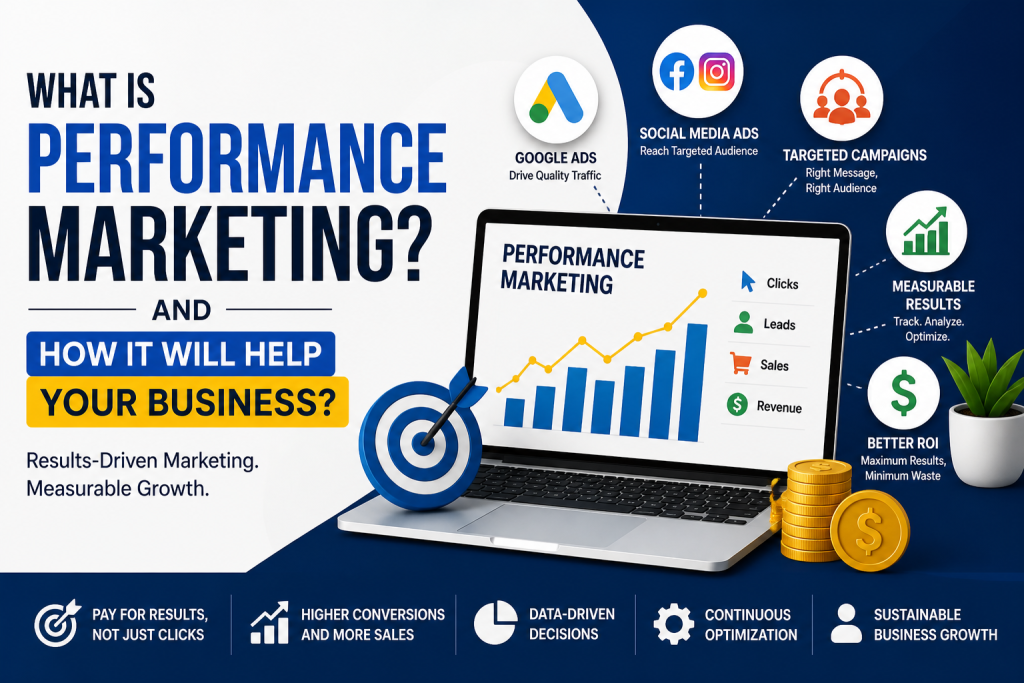
What Is Performance Marketing?
Performance marketing is a digital marketing strategy where advertisers pay based on specific results or actions rather than just exposure.
These actions may include:
- Website Clicks
- Lead Form Submissions
- Product Purchases
- App Installs
- Phone Calls
- Sign-Ups or Registrations
The core idea is simple: you spend marketing budget to drive measurable business outcomes.
This makes performance marketing highly accountable, data-driven, and ROI-focused.
How Performance Marketing Works?
Performance marketing campaigns are designed around clear goals and tracked through analytics tools.
The Basic Process:
- Define campaign objective
- Select target audience
- Create ad creatives/copy
- Launch campaigns on digital platforms
- Track performance metrics
- Optimize based on data
- Scale successful campaigns
Because every step is measurable, businesses can continuously improve campaign performance.
Popular Performance Marketing Channels
Performance marketing can be executed across multiple platforms depending on your business goals.
Google Ads
Reach users actively searching for products or services.
Meta Ads (Facebook & Instagram)
Target audiences based on demographics, interests, and behavior.
LinkedIn Ads
Ideal for B2B lead generation and professional targeting.
YouTube Ads
Build awareness while driving traffic and conversions.
Affiliate Marketing
Pay partners only when they generate sales or leads.
Native Advertising
Promote content through sponsored placements across websites.
Key Benefits of Performance Marketing for Businesses
1. Measurable ROI
One of the biggest advantages of performance marketing is full transparency into your return on investment.
You can track:
- Cost per click
- Cost per lead
- Cost per acquisition
- Revenue generated
- Conversion rate
This allows businesses to understand exactly where their money is going.
2. Budget Efficiency
Since campaigns are optimized for performance, your budget is spent on activities that drive actual business outcomes.
Instead of paying for vague exposure, you invest in campaigns that generate measurable value.
This makes performance marketing ideal for businesses of all sizes.
3. Faster Results Compared to Organic Marketing
SEO and organic growth are powerful but take time.
Performance marketing delivers immediate visibility and can generate leads or sales quickly once campaigns launch.
This makes it ideal for businesses that need:
- Fast lead generation
- Product launches
- Seasonal promotions
- Immediate sales growth
4. Precise Audience Targeting
Performance marketing platforms offer advanced targeting capabilities.
You can target users by:
- Age
- Gender
- Location
- Interests
- Behavior
- Search Intent
- Device Type
This ensures your campaigns reach the most relevant audience.
5. Scalability
Once a campaign is profitable, it can be scaled by increasing budget, expanding audiences, or launching additional campaigns.
Performance marketing allows businesses to grow in a predictable, data-backed way.
6. Better Decision Making Through Data
Campaign performance data helps businesses make smarter marketing decisions.
You can identify:
- Best-performing audiences
- Top-converting creatives
- Most profitable channels
- Weak campaign areas
This enables continuous optimization and better long-term strategy.
7. Supports Full Funnel Growth
Performance marketing can target users at every stage of the customer journey.
Top of Funnel
Generate awareness among new audiences.
Middle of Funnel
Retarget interested users and nurture leads.
Bottom of Funnel
Convert ready-to-buy prospects into customers.
This creates a complete growth ecosystem.
How Performance Marketing Helps Different Types of Businesses?
For Startups
Performance marketing helps startups:
- Generate quick traction
- Validate offers
- Build brand awareness
- Acquire first customers efficiently
For Local Businesses
Local businesses can use performance marketing to:
- Generate nearby leads
- Increase store visits
- Promote offers locally
- Dominate local search visibility
For E-commerce Brands
E-commerce businesses benefit by:
- Driving product sales
- Reducing cart abandonment
- Retargeting visitors
- Increasing average order value
For Service-Based Businesses
Agencies, consultants, and service providers can:
- Generate qualified leads
- Book consultations
- Increase inquiries
- Build authority in niche markets
Common Performance Marketing Metrics to Track
To measure success, businesses should monitor:
CTR (Click-Through Rate)
Measures how many users click your ad.
CPC (Cost Per Click)
Shows cost for each click.
CPL (Cost Per Lead)
Tracks cost of acquiring a lead.
CPA (Cost Per Acquisition)
Measures cost to acquire a customer.
ROAS (Return on Ad Spend)
Shows revenue earned per ad dollar spent.
Conversion Rate
Measures how many visitors complete desired action.
Tracking these metrics ensures campaigns remain profitable.
Common Mistakes Businesses Make in Performance Marketing
To succeed, avoid these mistakes:
Poor Targeting
Reaching irrelevant audiences wastes budget.
Weak Ad Creatives
Low-quality visuals and copy reduce performance.
No Conversion Tracking
Without tracking, optimization is impossible.
Sending Traffic to Weak Landing Pages
Ads fail if landing pages don’t convert.
Not Testing Variations
Performance improves through constant A/B testing.
Why Businesses Should Work With Experts?
While performance marketing is powerful, it requires expertise to execute effectively.
Successful campaigns need:
- Strategic audience targeting
- High-converting ad creatives
- Landing page optimization
- Conversion tracking setup
- Daily performance monitoring
- Continuous optimization
Working with professionals helps businesses avoid costly mistakes and maximize ROI.
Final Thoughts
Performance marketing has transformed how businesses grow online.
By focusing on measurable outcomes, precise targeting, and continuous optimization, performance marketing enables businesses to generate leads, increase sales, and scale efficiently.
If your business wants:
- Better ROI
- Faster lead generation
- Scalable growth
- Data-driven decisions
Then performance marketing should be a core part of your digital strategy.
Need Help With Performance Marketing?
At Digiplus, we create data-driven performance marketing campaigns that help businesses generate measurable growth and maximize ROI.
From Google Ads and Meta Ads to full-funnel campaign strategy, we help brands scale smarter.
Contact Digiplus today for a free consultation and discover how performance marketing can grow your business.